
Fool's priviledge
Eva Beresin
Via dei Banchi Vecchi 24, Rome
Opening September 17, 2026, 6 - 8 PM

Via dei Banchi Vecchi 24, Rome
Opening September 17, 2026, 6 - 8 PM
“Perhaps we see most clearly when we stop pretending we know everything. To see clearly means taking the risk of no longer belonging. And sadly, the truth is often heard when it can no longer be ignored.”
— Eva Beresin
Amanita is pleased to present Fool’s Privilege, Eva Beresin’s second solo exhibition with the gallery, bringing together a selection of paintings and sculptures produced over the last year, presented in Rome.
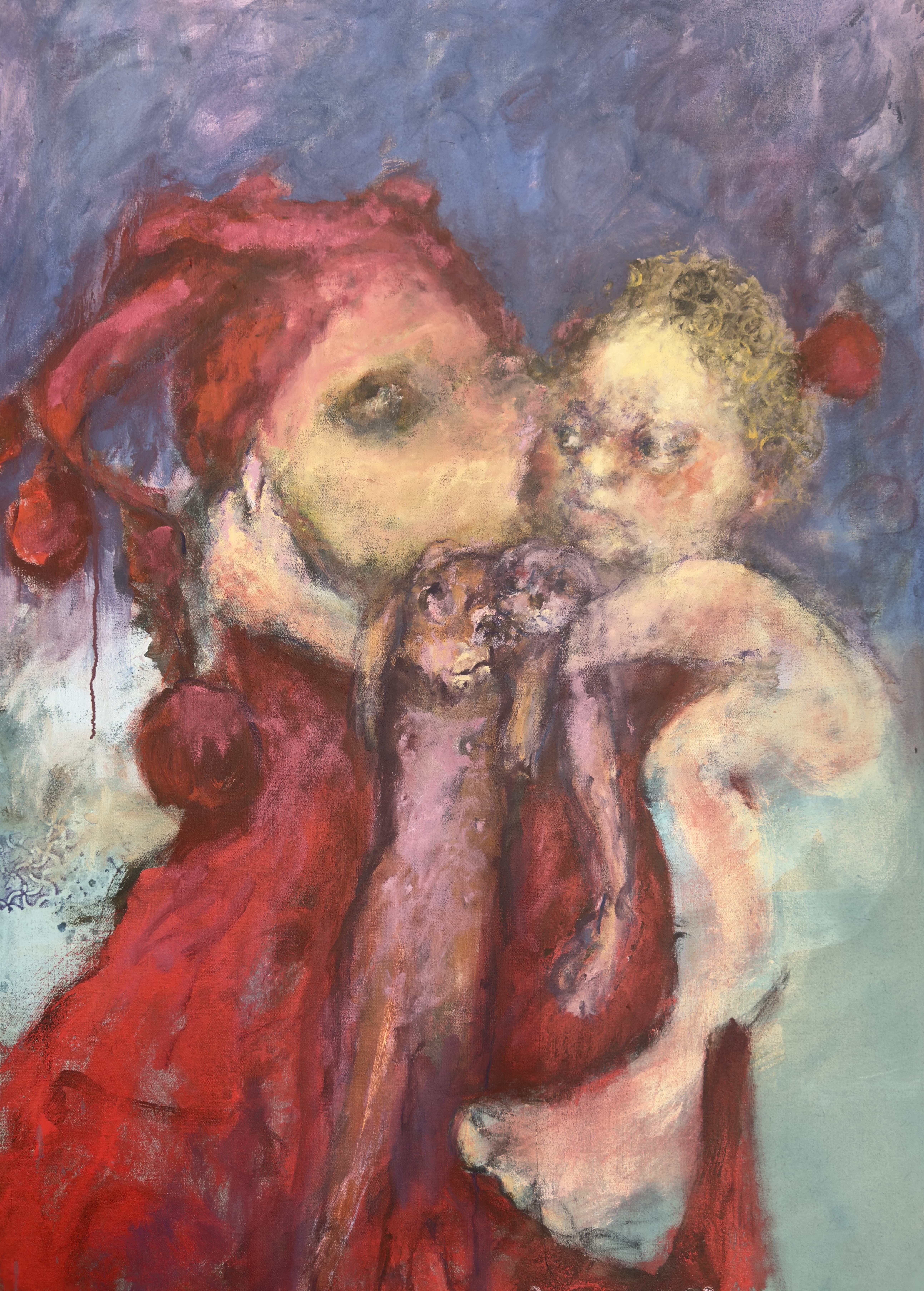
A familiar cast of characters from Beresin’s mythology inhabits the works: babies, children, naked bodies, dogs and stuffed animals. This time, a new figure enters the scene: the fool. Historically, the fool occupies a peculiar position. Close to authority as entertainer, idiot, satirist and sometimes oracle, he is at once subordinate to power and partially exempt from its rules. He is permitted to say the inappropriate, the obvious, even the truth, precisely because he is not taken entirely seriously. The fool’s privilege depends on his position outside conventional authority.
In the exhibition, this condition finds a parallel in another recurring figure: the baby. Babies, children, little angels and putti appear throughout the works, sharing with the fool a similar freedom from ordinary codes of behaviour. Neither has authority, yet both are allowed to stare, exaggerate, play, interrupt, say or do the wrong thing. In the sculpture Determined sights of Nature, Magic can create salvation, this relationship is made physical. An enormous baby bears down on a much smaller adult who struggles to support it. Elsewhere, children peer through windows at scenes that appear frightening, violent or absurd. Both the fool and the child are present within these worlds, but never entirely subject to their rules.
The draping canvas-tapestry depicts Palazzo dei Pupazzi, the building that houses the gallery, its rooms inhabited by Beresin’s characters. The smaller paintings almost feel like individual scenes extracted from this central image, as though each offers a closer view into one of its rooms. The palazzo, carrying centuries of accumulated histories, lives, pleasures and violence, is not a neutral container. Beresin’s imagination itself becomes architectural and compartmentalised. Windows become thresholds between inside and outside, separating one space from another while still permitting vision between them. We look in as figures look out, never quite certain who is watching whom.
Beresin is interested in the architectural features of the gallery, the vitrines, windows, doors and chequered floor, as structures through which to organise and compose her work. There is a nod to the Renaissance history of the palazzo and its interest in perspective, proportion and the organisation of bodies and space. The dimensions of the canvases themselves are dictated by the golden ratio, yet within them bodies swell, shrink and deform. As always in Beresin’s work, attention is on the flesh, the grotesque, the macabre and the caricatural, as well as the innocent, the playful and the sweet. Small babies become putti with Renaissance-style curls, dangerously cute.
Beresin is addressing the medium of painting and confronting its history. There is something almost Mannerist, even Pontormo-esque, in the deformation of Renaissance ideals of proportion and mastery: elongated, improbable bodies, unstable spaces and impossible physical supports, recalling Pontormo’s Deposition. In Beresin’s work too, distortion depends upon her understanding of proportion. She knows where the body ends before making it go too far, opening the possibility that what appears foolish, childish, grotesque or absurd might also be worth listening to.
— Isabella Tucci